
PCB Manufacturing Quotation Checklist for Product Teams
Prepare a PCB manufacturing quotation package with revision-controlled files, assembly requirements, test criteria and clear supplier responsibilities.
Updated
A PCB manufacturing quotation is useful only when the supplier understands exactly what must be delivered. Bare boards, assembled PCBs and complete electronic equipment have different information needs and responsibility boundaries.
For CTOs and product teams comparing manufacturing options in Asia or Europe, the first task is to prepare a consistent technical package. Supplier location alone does not establish whether two offers cover the same work.
This checklist focuses on manufacturing an existing design. If electronics or firmware development is still required, separate that engineering work from the manufacturing quotation.
1. Define the item being purchased
Specify whether the order covers bare printed circuit boards, assembled boards, programmed and tested assemblies, or complete equipment with enclosure and wiring. State what your team will supply and what the manufacturing partner must procure or coordinate.
Include prototype quantities, the initial production batch and any provisional repeat-order quantities. Label forecasts as estimates. Ask suppliers to distinguish setup costs, recurring unit costs and separately charged engineering activities.
Explain the intended use and installation environment so that suppliers can identify questions requiring engineering review. Do not leave them to infer product requirements from a board drawing.
2. Issue one controlled manufacturing package
Use a release identifier that connects the board design, bill of materials, assembly information and firmware version. Include a file list and identify which files govern the quotation.
| Package element | Information to make explicit |
|---|---|
| PCB manufacturing files | Gerbers, drill files, board dimensions and fabrication specifications |
| Bill of materials | Reference designators, quantities, manufacturer part numbers and component population status |
| Placement data | Component coordinates, orientation, board side and the coordinate convention used |
| Assembly information | Assembly drawings, polarity, special handling and mechanical constraints |
| Programming information | Applicable firmware release, programming method and responsibility for supplying the release |
| Test requirements | Checks, acceptance criteria, required records and treatment of failed units |
Ask the supplier to identify missing or inconsistent information before accepting the package. If the design changes after quotation, issue a new revision and request confirmation of its effect on price, material orders and schedule.
3. Agree component purchasing and substitutions
State whether purchasing is supplier-managed, client-supplied or a combination. For client-supplied components, agree quantities, packaging, delivery responsibilities and how shortages or unusable parts will be handled.
Distinguish approved alternatives from parts that require engineering approval. A similar footprint or headline specification does not establish interchangeability: electrical behaviour, firmware dependencies, thermal limits and assembly requirements may also matter.
Ask each supplier to identify availability assumptions and components that constrain the proposed schedule. Define who can approve substitutions and how the resulting BOM revision will be recorded. Do not allow an unresolved sourcing assumption to become an undocumented production change.
4. Define assembly and integration requirements
Identify relevant through-hole and surface-mount components, connectors, mechanical attachments and any assembly steps outside standard board population. Describe enclosure integration, wiring or accessories if these are included in the purchase.
For components with special assembly requirements, request confirmation that the supplier has reviewed the package and can explain the proposed process. Ask which inspection activities are included and what evidence will accompany delivery.
Where a specific manufacturing standard or certification is a purchasing requirement, name it in the brief and request evidence covering the actual supplier, site and activity. Do not assume that a general statement about a supplier network establishes coverage for your order.
5. Separate inspection, programming and functional testing
An assembled board is not necessarily a programmed or functionally tested product. Define these activities separately in the quotation.
- Inspection: Specify which assembly checks are required and how defects will be handled.
- Programming: Identify the firmware release, programming interface and verification step. Agree how product-specific configuration is assigned where applicable.
- Functional testing: Define the inputs, operating conditions, measured outputs and pass/fail limits needed for acceptance.
- Records: Specify which results must be retained or delivered and how they relate to individual units or batches.
Agree who designs, supplies and maintains any test fixture. If no production test procedure exists, request its development as an explicit engineering activity rather than assuming it is included in assembly pricing.
Production checks also serve a different purpose from design validation. If the design still needs electrical, firmware or robustness assessment, discuss that work separately through Pleeda's electronic circuit validation service.
6. Establish a first-batch decision point
Before committing to a larger order, agree whether an initial batch will be reviewed and what evidence is needed to proceed. Define who approves that decision and which unresolved issues would prevent release of further units.
Record discrepancies against the released package. When a correction is required, distinguish manufacturing rework from a design change, identify affected units and update the relevant documentation.
Avoid treating a successful demonstration of one board as acceptance of an entire production batch. Acceptance should follow the agreed checks and sampling or unit-test requirements for the order.
7. Compare the complete delivery scope
Use the same package when requesting quotations from suppliers in different locations. Ask each supplier to identify exclusions and assumptions rather than comparing unit price alone.
Check whether the quotation includes component purchasing, setup, assembly, programming, inspection, functional testing, fixtures, packaging and delivery. Clarify the delivery point and responsibility for freight, import arrangements and associated costs where relevant.
Request a schedule that identifies dependencies: package approval, component availability, client-supplied materials and first-batch acceptance. A quoted lead time is difficult to assess without knowing when its clock starts.
What to send Pleeda
For an initial discussion, prepare the current manufacturing files, BOM, board revision, required quantities, project stage and known technical issues. Add your programming and test requirements, intended delivery location and any date constraints. Mark missing information clearly.
Pleeda's PCB manufacturing and assembly management service covers prototypes through production and coordinates manufacturing with suppliers in Asia and Europe. If the design package needs further engineering, review the PCB design service.
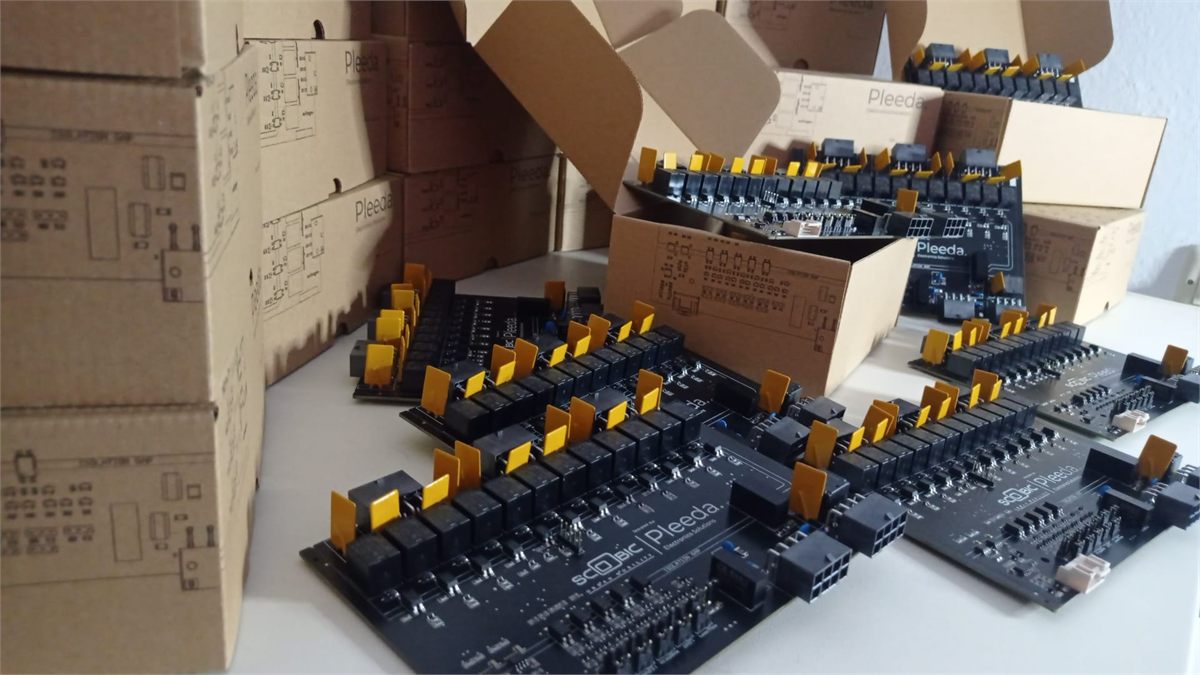
The accompanying photograph shows PCB assemblies from Pleeda's Scoobic last-mile vehicle project. It illustrates an actual Pleeda project; it does not specify the board, manufacturing location or acceptance process for your order.
Discuss your PCB manufacturing requirements with Pleeda. Share the available package and the decisions you need help resolving so the scope can be assessed before quotation.
References
- Pleeda PCB manufacturing and assembly management: manufacturing coordination, assembly and supported production quantities.
- Pleeda PCB design: Gerbers, BOM, placement data and manufacturing documentation.
- Pleeda electronic circuit validation: specification-based hardware and firmware assessment.